
Fairuz is a Lebanese singer widely considered one of the most celebrated voices in the Arab world and a symbol of modern Lebanon. This Fairuz biography follows Nouhad Haddad from a one-room home in Beirut to stages across the world, through her work with the Rahbani family and her enduring songs.
Featured photo: Unknown photographer (AP), Public domain, via Wikimedia Commons
Quick Facts About Fairuz
- Real name: Nouhad Wadie Haddad
- Born: 20 November 1934 or 21 November 1935, Lebanon
- Grew up in: Zuqaq al-Blat, Beirut
- Profession: singer and actress
- Career start: chorus singer at Lebanese national radio, around 1950
- First major hit: “Itab” (1952)
- Key collaborators: the Rahbani brothers, Assi and Mansour, and later her son Ziad Rahbani
- Nicknames: “The Voice of Lebanon”, “The Bird of the East”, “Our Ambassador to the Stars”
- Spouse: Assi Rahbani (married 1955; died 1986)
- Children: Ziad (1956–2025), Hali, Layal and Rima
Early Life
Fairuz was born Nouhad Wadie Haddad. Sources give her birth date as 20 November 1934 or 21 November 1935.
Her father, Wadie, was an Assyrian Christian born in Mardin (in present-day Turkey) who moved to Lebanon. Her mother, Lisa al-Boustani, came from the village of Dibbiyeh in Mount Lebanon.
A modest home in Beirut
The family moved to Zuqaq al-Blat, a neighbourhood in Beirut. They lived in a single room and shared a kitchen with neighbours.
As a schoolgirl she sang at school events. In 1950 the musician Mohammed Flayfel heard her and helped her join the chorus of the national radio station.
Career Journey
Radio and a new name
At the radio station she met composer Halim el Roumi, who gave her the stage name Fairuz, meaning turquoise. He also introduced her to the brothers Assi and Mansour Rahbani.
The Rahbani partnership
Her first major hit, “Itab”, was released in 1952 and made her a star across the Arab world. The Rahbani brothers wrote and composed most of her work for the next two decades.
She married Assi Rahbani on 23 January 1955. The partnership changed Lebanese music by blending Arabic melody with Western orchestration and shorter song forms.
Baalbeck and musical theatre
In 1957 she performed for the first time at the Baalbeck International Festival. President Camille Chamoun awarded her a medal of honour.
She and the Rahbanis returned to Baalbeck most years until the civil war. They staged musical plays that became central to Lebanese culture.
Singing for the Arab world
Through the 1950s and 1960s her fame spread to Damascus, Amman, Cairo, Rabat, Algiers and Tunis. She later performed at the Royal Albert Hall, Carnegie Hall and the Olympia in Paris.
Her songs about Jerusalem and Beirut, including “Zahrat al-Mada’en”, became anthems for many listeners.
War years and Ziad Rahbani
During Lebanon’s civil war (1975–1990) she refused to take sides and did not perform in Lebanon. Her songs were heard on all sides of the conflict.
After an artistic split with the Rahbani brothers in 1979, she worked mainly with her son Ziad Rahbani. His jazz-influenced style gave her music a new, modern voice.
Return to Beirut
In September 1994 she gave a historic concert in Beirut’s Martyrs’ Square to mark the rebuilding of the city centre. In 2017 she released Bebalee, produced by her daughter Rima.
Voice and influence
Her clear, gentle voice and restrained style set her apart from many earlier Arab singers. Her songs are often shorter than traditional Arabic pieces and were well suited to radio.
Across a career of more than six decades she recorded around 1,500 songs, released more than 80 albums and appeared in about 20 musicals. She is among the best-selling artists from the Middle East.
Her morning songs are a daily ritual for many listeners in Lebanon and neighbouring countries. Her music continues to be covered by younger Arab artists.
Career Highlights
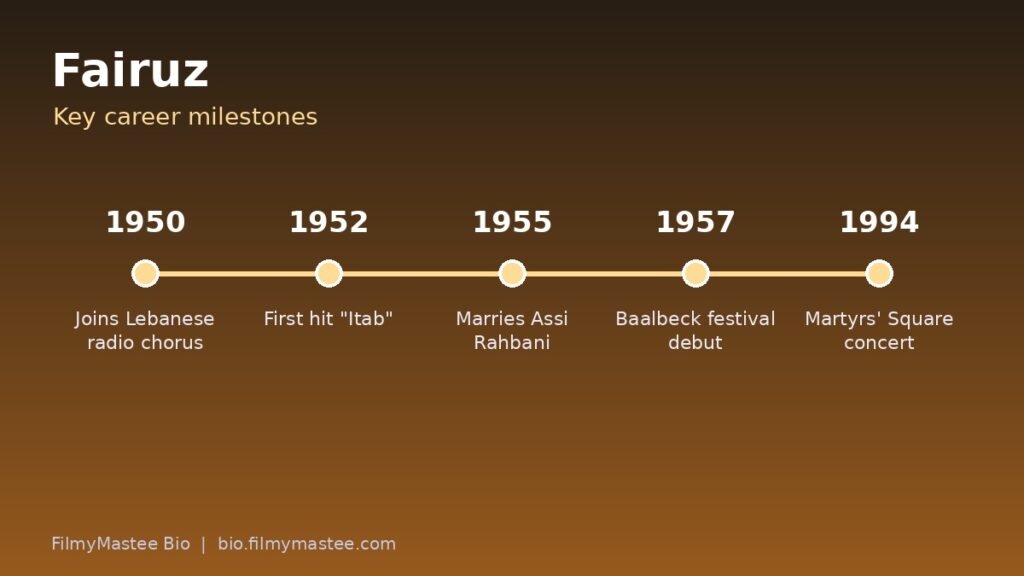
- 1950 – joins the Lebanese radio chorus
- 1952 – first major hit, “Itab”
- 1955 – marries Assi Rahbani
- 1957 – first Baalbeck International Festival performance
- 1960s – concerts across the Arab world
- 1979 onwards – new era of music with Ziad Rahbani
- 1994 – Martyrs’ Square concert in Beirut
- 2017 – album Bebalee
- Honours from Lebanon, Jordan, Tunisia and France, including the Legion of Honour (1998)
Personal Life
She married Assi Rahbani in 1955, converting to Greek Orthodoxy. Assi died in 1986.
The couple had four children. Ziad (1956–2025) was a composer and playwright; Hali was disabled from childhood after meningitis; Layal died young in 1988; and Rima is a filmmaker who has produced her mother’s recent work.
The singer is famously private and rarely gives interviews. In 2020, after the Beirut port explosion, French president Emmanuel Macron visited her at home.
Read more inspiring music stories on FilmyMastee Bio, including A. R. Rahman, Taylor Swift and Chimamanda Ngozi Adichie, or open the Fairuz profile page.
Sources: Wikipedia – Fairuz and Wikipedia – Rahbani brothers.
Frequently Asked Questions about Fairuz
What is Fairuz’s real name?
Fairuz was born Nouhad Wadie Haddad.
Why is Fairuz famous?
Fairuz is one of the best-known singers in the Arab world, famed for decades of songs and musicals with the Rahbani brothers.
Who was Fairuz married to?
She married composer Assi Rahbani in 1955. He died in 1986.
Who is Ziad Rahbani?
Ziad Rahbani (1956–2025) was Fairuz’s eldest son, a composer and playwright who shaped her music from the late 1970s.
Did Fairuz sing during the Lebanese civil war?
She did not perform in Lebanon during the 1975–1990 civil war, but she recorded and toured abroad.