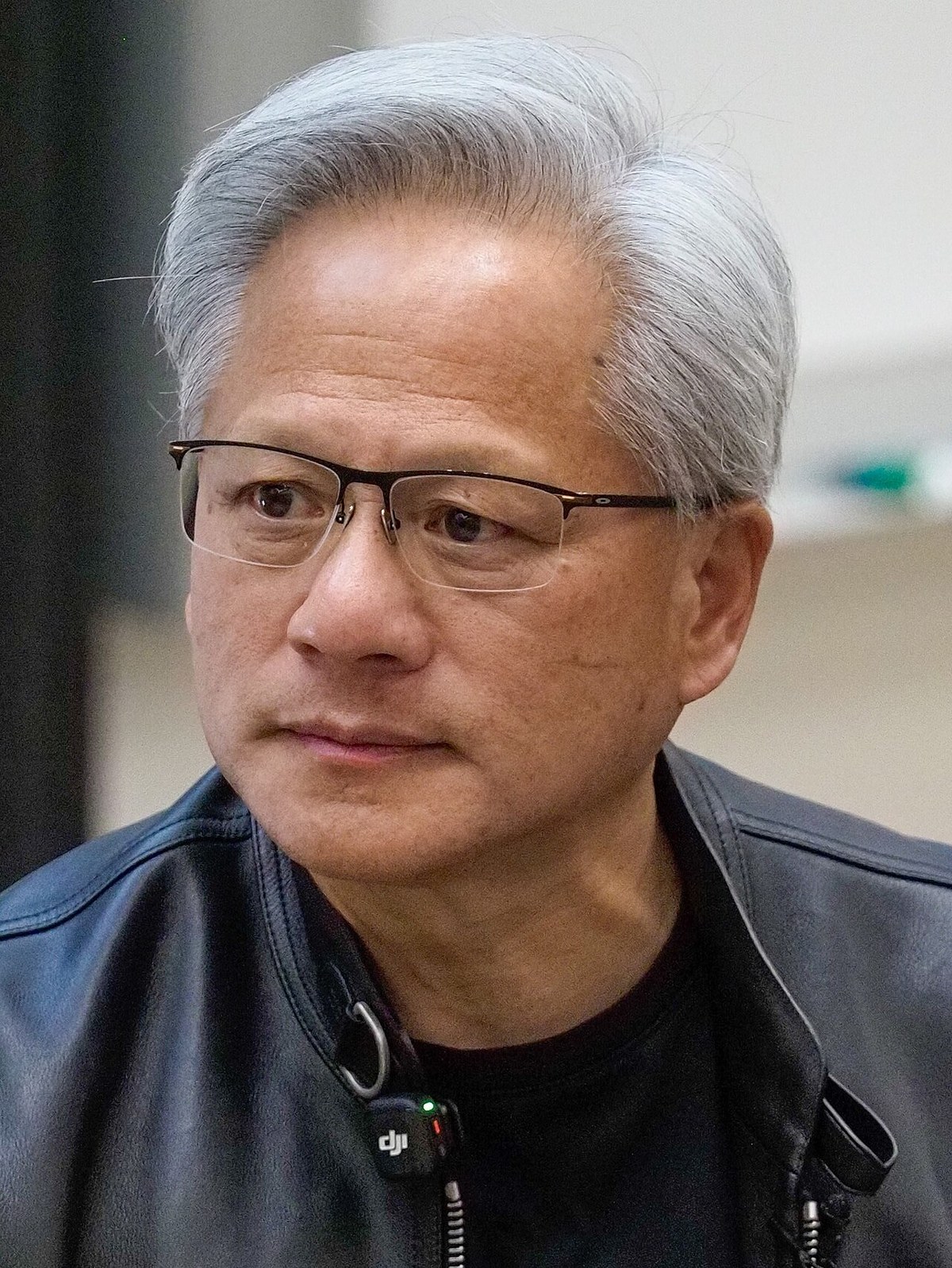
Jensen Huang is the co-founder, president and chief executive of Nvidia, the chip company at the centre of the artificial intelligence boom. This Jensen Huang biography follows his journey from an immigrant child in Kentucky to the leader of one of the world’s most valuable companies.
Featured photo: Anderseidesvik, CC BY-SA 4.0, via Wikimedia Commons
Quick Facts About Jensen Huang
- Full name: Jen-Hsun “Jensen” Huang
- Born: 17 February 1963, Taipei, Taiwan
- Nationality: Taiwanese American
- Education: BS in electrical engineering, Oregon State University (1984); MS in electrical engineering, Stanford University (1992)
- Early employers: AMD and LSI Logic
- Company: Nvidia (co-founded 1993)
- Role: president and CEO since 1993
- Co-founders: Chris Malachowsky and Curtis Priem
- Spouse: Lori Huang
- Children: Spencer and Madison
Early Life
Jensen Huang was born on 17 February 1963 in Taipei, Taiwan. He moved to the southern city of Tainan as a child and later spent part of his childhood in Thailand.
His parents sent him and his brother to relatives in the United States. The boys were enrolled at the Oneida Baptist Institute in Kentucky, which the family mistakenly believed was a prestigious boarding school.
Kentucky and Oregon
At Oneida he faced bullying as a small immigrant boy who spoke little English. He later said the hardship taught him resilience.
His parents joined the family in Oregon. From the age of 15 he worked at a Denny’s restaurant as a dishwasher, busboy and waiter.
Engineering studies
Jensen Huang earned a bachelor’s degree in electrical engineering from Oregon State University in 1984. There he met his future wife, Lori Mills, who was his lab partner.
He later completed a master’s degree in electrical engineering at Stanford University in 1992.
Career Journey
AMD and LSI Logic
After college he designed microprocessors at AMD. He then moved to LSI Logic, where he worked with engineers Chris Malachowsky and Curtis Priem.
Founding Nvidia
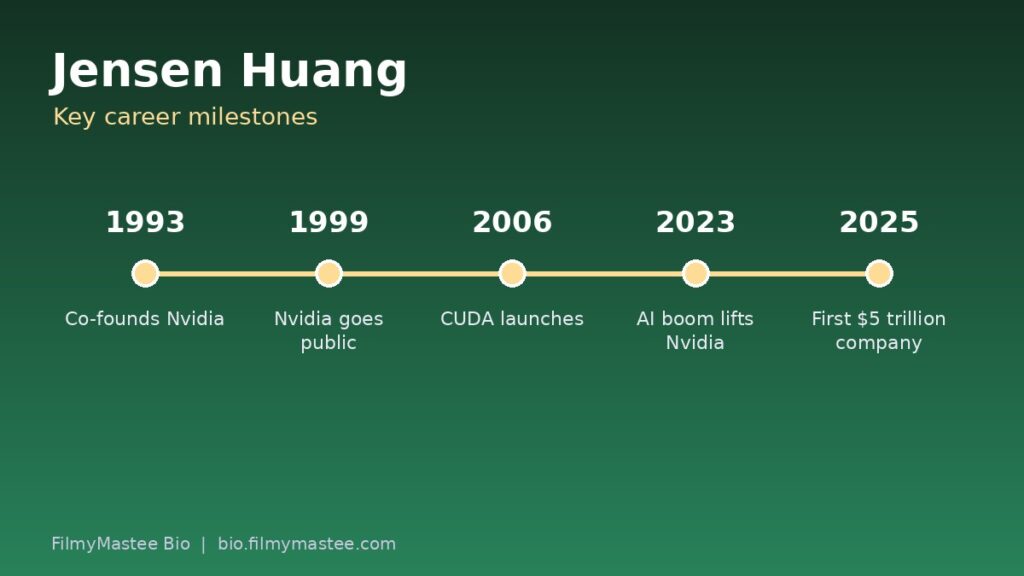
In 1992 the three met often at a Denny’s diner in East San Jose to plan a graphics chip company. Nvidia was founded in April 1993, with Jensen Huang as president and CEO at the age of 30.
The young company came close to bankruptcy in the 1990s. Its RIVA chips and a sharp focus on PC gaming graphics helped it survive.
The GPU and CUDA
Nvidia went public in 1999 and launched the GeForce 256, which it marketed as the world’s first GPU. Graphics processors soon became central to PC gaming.
In 2006 Nvidia introduced CUDA, a platform that let developers use GPUs for general computing. The bet took years to pay off, but it laid the foundation for modern AI.
Leading the AI boom
Researchers began training deep neural networks on Nvidia GPUs in the early 2010s. Jensen Huang pushed the company to build data-centre chips, networking and software for AI.
When generative AI took off from 2022, demand for Nvidia’s chips soared. In October 2025 Nvidia became the first company to reach a market value of $5 trillion.
Recognition
Time included Jensen Huang among its most influential people in 2021 and 2024. In 2025 the magazine named him one of the “Architects of AI” for its Person of the Year.
He is known on stage for his trademark black leather jacket and long keynote presentations.
Leadership style
He is known for a flat management structure, with dozens of executives reporting directly to him. He prefers sharing information openly with large groups rather than holding one-on-one meetings.
He has often said that Nvidia came close to failure more than once and that the company still acts as if it is “30 days from going out of business”. That mindset, he says, keeps the company focused.
His keynote presentations at events such as GTC and Computex attract a large global audience. They are watched closely by investors and engineers for signs of where AI computing is heading.
Career Highlights
- 1984 – electrical engineering degree, Oregon State University
- 1993 – co-founds Nvidia and becomes CEO
- 1999 – Nvidia IPO and GeForce 256 launch
- 2006 – CUDA computing platform launches
- 2010s – Nvidia GPUs power deep learning research
- 2023 – Nvidia passes $1 trillion in market value
- 2025 – Nvidia becomes the first $5 trillion company
- 2025 – named among Time‘s “Architects of AI”
Personal Life
Jensen Huang married Lori Mills, his lab partner from Oregon State. They have two children, Spencer and Madison.
In 2007 the couple set up the Jen-Hsun & Lori Huang Foundation. In 2022 they gave $50 million toward a new research and education centre at Oregon State University.
He also funded the Jen-Hsun Huang Engineering Center at Stanford University.
Read more inspiring business stories on FilmyMastee Bio, including Sundar Pichai, Ratan Tata and MrBeast, or open the Jensen Huang profile page.
Sources: Wikipedia – Jensen Huang and Nvidia – Jensen Huang.
Frequently Asked Questions about Jensen Huang
When was Jensen Huang born?
Jensen Huang was born on 17 February 1963 in Taipei, Taiwan.
When did Jensen Huang found Nvidia?
He co-founded Nvidia in April 1993 with Chris Malachowsky and Curtis Priem.
Where did Jensen Huang study?
He studied electrical engineering at Oregon State University and earned a master’s degree from Stanford University.
Why is Nvidia important for AI?
Nvidia’s GPUs and CUDA software are widely used to train and run AI models, which made the company central to the AI boom.
Who is Jensen Huang’s wife?
He is married to Lori Huang, whom he met at Oregon State University. They have two children, Spencer and Madison.