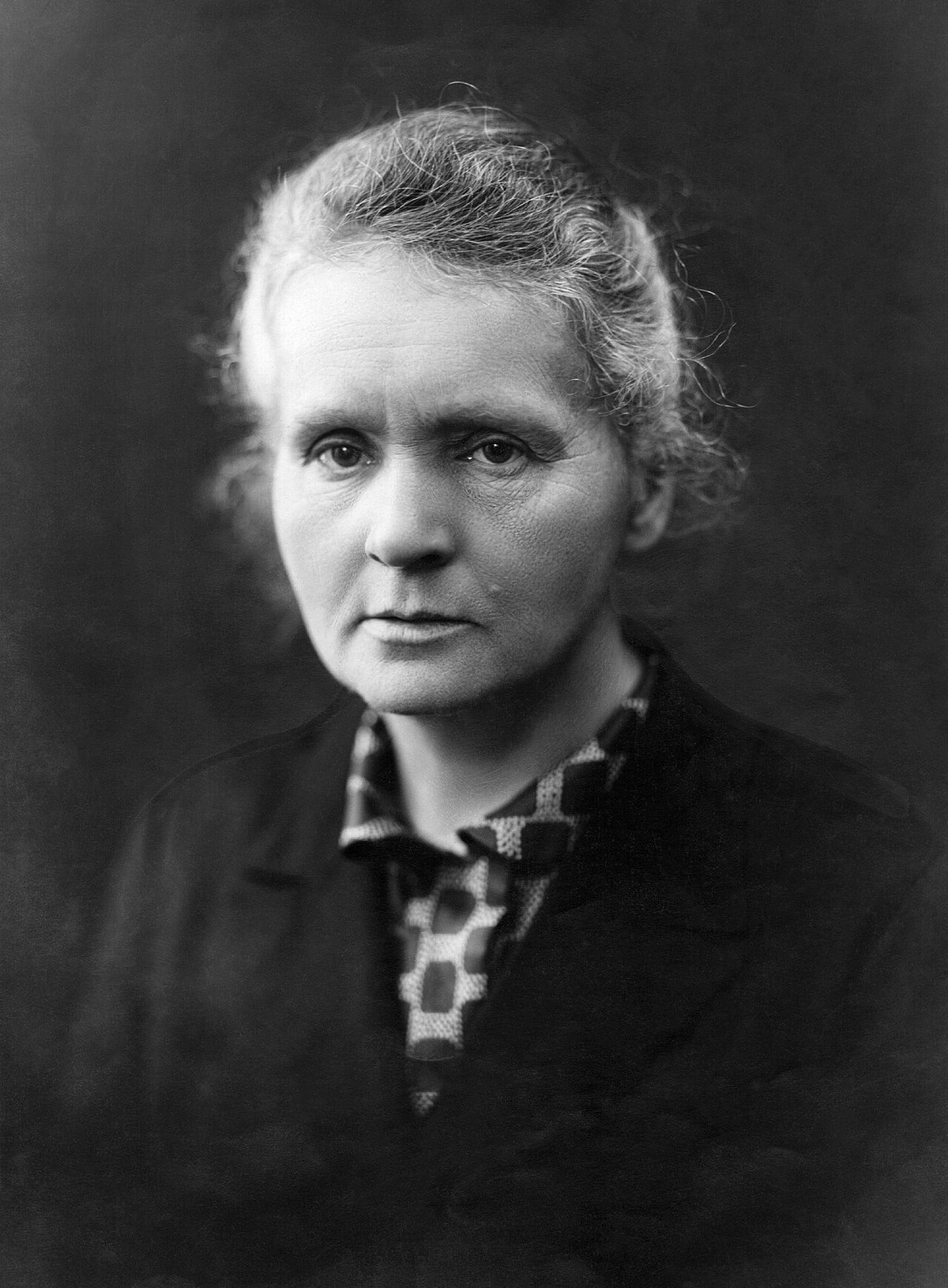
Marie Curie was a Polish and naturalised-French physicist and chemist whose research on radioactivity changed science and medicine. This Marie Curie biography covers her childhood in Warsaw, her discoveries with Pierre Curie, her two Nobel Prizes and her lasting legacy.
Featured photo: Henri Manuel, Public domain, via Wikimedia Commons
Quick Facts About Marie Curie
- Full name: Maria Salomea Skłodowska Curie
- Born: 7 November 1867, Warsaw (then Russian Empire)
- Died: 4 July 1934, Passy, Haute-Savoie, France, aged 66
- Fields: physics and chemistry
- Education: University of Paris (Sorbonne) – degrees in physics (1893) and mathematics (1894)
- Spouse: Pierre Curie (married 1895; died 1906)
- Children: Irène Joliot-Curie and Ève Curie
- Discoveries: polonium and radium (1898)
- Nobel Prizes: Physics (1903) and Chemistry (1911)
- Firsts: first woman to win a Nobel Prize and only person to win Nobels in two sciences
Early Life
Marie Curie was born Maria Skłodowska on 7 November 1867 in Warsaw, then part of the Russian Empire. Both her parents were teachers, and she was the youngest of five children.
Her family lost much of its property because of support for Polish independence. Her mother died of tuberculosis when Maria was 10.
The Flying University
Women could not enrol in regular universities in Russian-ruled Poland. Maria and her sister Bronisława joined the clandestine Flying University, which secretly admitted women.
She worked as a governess and tutor to help pay for Bronisława’s medical studies in Paris. The sisters agreed that Bronisława would later support Maria in turn.
Career Journey
Studies in Paris
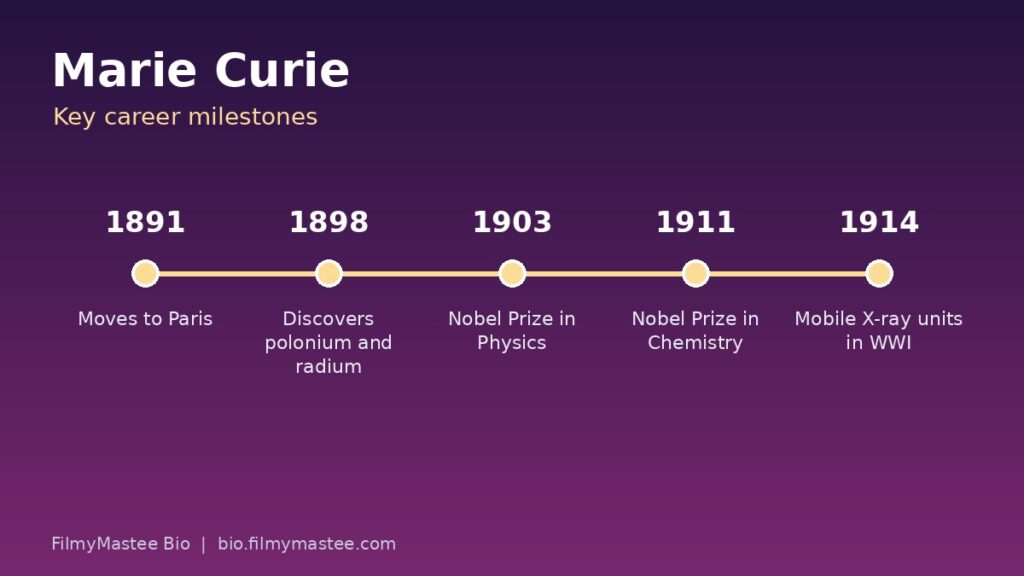
In 1891 Marie Curie moved to Paris and enrolled at the Sorbonne. She lived in a cheap attic room on very little money while she studied.
She earned a degree in physics in 1893 and in mathematics in 1894. That year she met the physicist Pierre Curie.
Marriage and partnership
She married Pierre Curie in 1895. The couple shared a laboratory and a deep commitment to research.
Their first daughter, Irène, was born in 1897. Their second daughter, Ève, followed in 1904.
Polonium and radium
Inspired by Henri Becquerel’s discovery of uranium rays, Marie Curie studied pitchblende, a uranium ore. She found it was more radioactive than uranium alone.
In 1898 she and Pierre announced two new elements. She named the first polonium, after her homeland, and the second radium. She also coined the term “radioactivity”.
First Nobel Prize
In 1903 Marie Curie, Pierre Curie and Henri Becquerel shared the Nobel Prize in Physics for their work on radioactivity. She became the first woman to win a Nobel Prize.
Tragedy and a second Nobel
In 1906 Pierre was killed in a street accident in Paris. Marie took over his teaching post and became the first woman professor at the University of Paris.
In 1911 she won the Nobel Prize in Chemistry for discovering radium and polonium and isolating radium. She remains the only person to win Nobel Prizes in two different sciences.
War work and institutes
During the First World War she developed mobile X-ray units, nicknamed “petites Curies”, to help surgeons at the front. She also trained women to operate them.
She founded the Curie Institute in Paris in 1920 and another in Warsaw in 1932. Both remain major medical research centres.
Scientific legacy
Her research laid the foundations of nuclear physics and radiation therapy for cancer. The curie, a unit of radioactivity, and the element curium are named in honour of Marie and Pierre Curie.
She refused to patent the process for isolating radium, so that other scientists could use it freely. She also travelled to the United States in 1921 to raise funds for radium for her research.
Her notebooks from the 1890s are still radioactive and are kept in lead-lined boxes in Paris. Researchers who wish to consult them must sign a liability waiver and wear protective clothing.
Major Achievements
- Coined the term “radioactivity”
- Discovered polonium and radium in 1898
- Nobel Prize in Physics, 1903 – first woman Nobel laureate
- First woman professor at the University of Paris, 1906
- Nobel Prize in Chemistry, 1911
- Mobile X-ray units during the First World War
- Founded the Curie Institutes in Paris (1920) and Warsaw (1932)
- First woman entombed on her own merits in the Panthéon (1995)
Personal Life
Marie Curie was married to Pierre Curie from 1895 until his death in 1906. Their daughter Irène Joliot-Curie later won the 1935 Nobel Prize in Chemistry with her husband, Frédéric Joliot-Curie.
Their younger daughter, Ève Curie, became a writer and wrote the well-known biography Madame Curie. The family legacy includes five Nobel Prizes.
She kept a strong Polish identity, taught her daughters Polish and named polonium after her homeland. She died on 4 July 1934 of aplastic anaemia, likely caused by long exposure to radiation.
Read more inspiring life stories on FilmyMastee Bio, including Chimamanda Ngozi Adichie, Jensen Huang and Hayao Miyazaki, or open the Marie Curie profile page.
Sources: Wikipedia – Marie Curie and NobelPrize.org – Marie Curie facts.
Frequently Asked Questions about Marie Curie
What did Marie Curie discover?
Marie Curie discovered the elements polonium and radium in 1898 with Pierre Curie and coined the term “radioactivity”.
How many Nobel Prizes did Marie Curie win?
She won two: the 1903 Nobel Prize in Physics and the 1911 Nobel Prize in Chemistry.
Where was Marie Curie born?
She was born in Warsaw on 7 November 1867, when the city was part of the Russian Empire.
How did Marie Curie die?
She died on 4 July 1934 of aplastic anaemia, likely caused by her long exposure to radiation.
Who were Marie Curie’s children?
Her daughters were Irène Joliot-Curie, a Nobel-winning chemist, and Ève Curie, a writer.