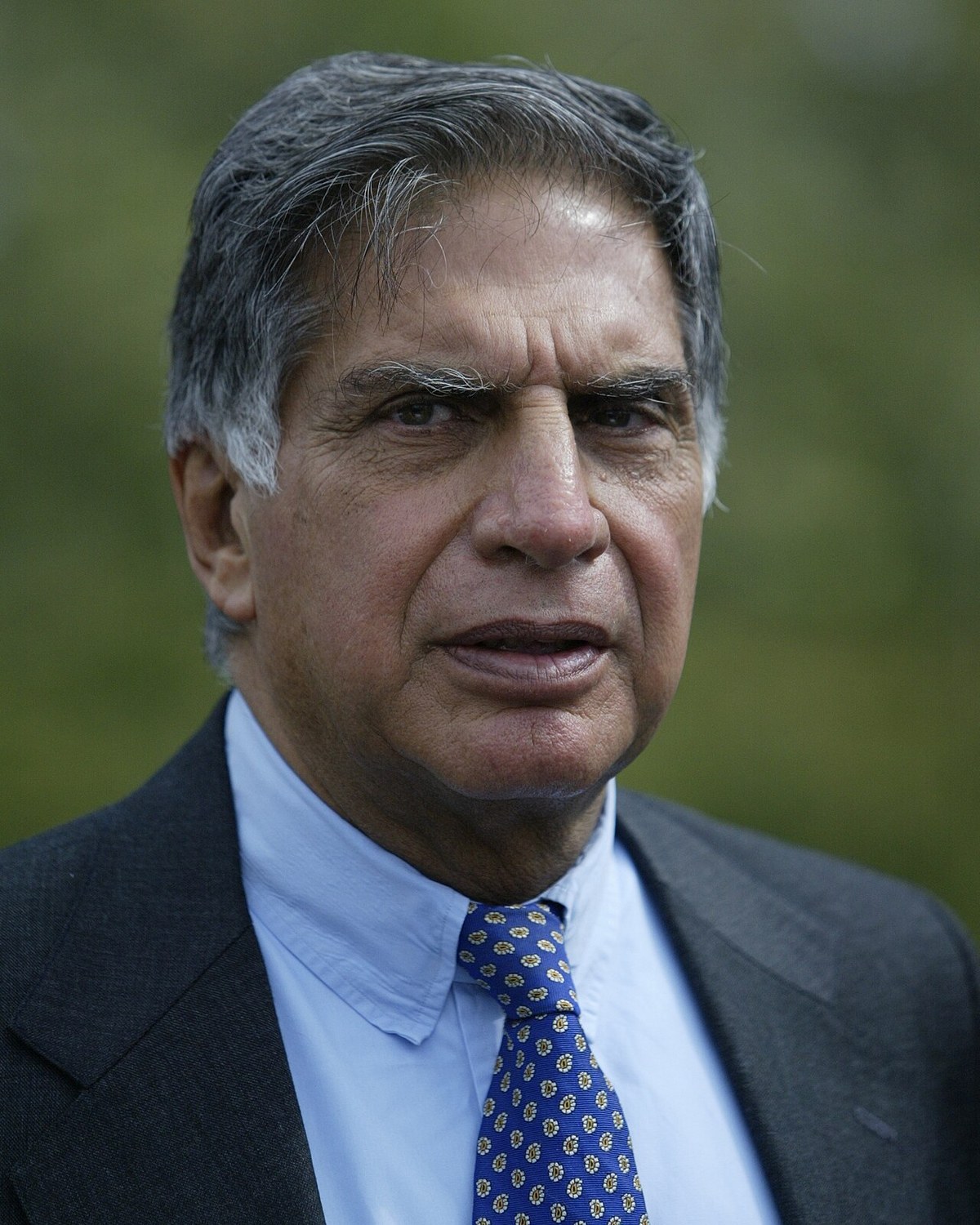
Ratan Tata was an Indian industrialist and philanthropist who led the Tata Group for more than two decades and turned it into a global business. This Ratan Tata biography covers his childhood in Bombay, his start on the shop floor, his landmark acquisitions and the charitable legacy he left behind.
Featured photo: Universitätsarchiv St. Gallen, CC BY-SA 4.0, via Wikimedia Commons
Quick Facts About Ratan Tata
- Full name: Ratan Naval Tata
- Born: 28 December 1937, Bombay (now Mumbai), India
- Died: 9 October 2024, Mumbai, aged 86
- Parents: Naval Tata and Sooni Tata
- Raised by: grandmother Navajbai Tata
- Education: B.Arch, Cornell University (1962); Advanced Management Program, Harvard Business School (1975)
- Chairman of Tata Group and Tata Sons: 1991–2012
- Interim chairman: October 2016 – February 2017
- Civilian honours: Padma Bhushan (2000), Padma Vibhushan (2008)
- Marital status: never married
Early Life
Ratan Tata was born on 28 December 1937 in Bombay. His father, Naval Tata, had been adopted by Ratanji Tata, a son of the group’s founder Jamsetji Tata.
In 1948, when he was 10, his parents separated. He was raised by his grandmother, Navajbai Tata, who remained a strong influence throughout his life.
Education
He studied at Campion School and Cathedral and John Connon School in Bombay. He then went to Cornell University in the United States and graduated with a bachelor’s degree in architecture in 1962.
Years later, in 1975, he attended the Advanced Management Program at Harvard Business School.
Career Journey
Starting on the shop floor
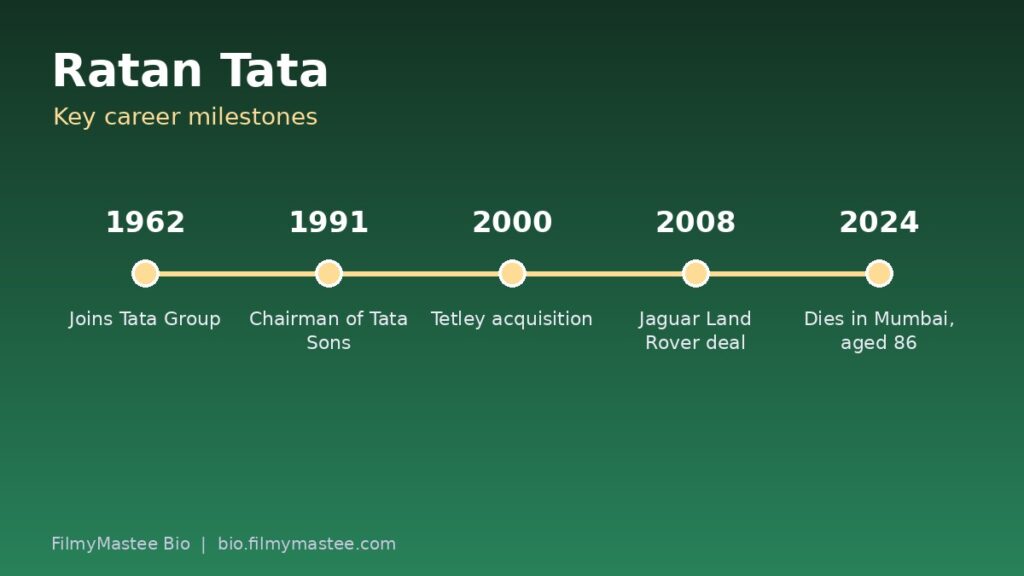
He joined the Tata Group in 1962. He began on the shop floor of Tata Steel in Jamshedpur, working alongside ordinary employees.
He later managed group companies including the electronics firm Nelco. These years gave him a close understanding of operations and workers.
Chairman of Tata Sons
In 1991 he succeeded J. R. D. Tata as chairman of Tata Sons. The appointment came the same year India began opening its economy to the world.
He worked to bring the group’s many companies under a common strategy and brand. He also encouraged younger leadership and a stronger focus on technology.
Building Indian cars
Under his leadership, Tata Motors launched the Tata Indica in 1998, one of the first passenger cars designed and developed in India.
In 2008 the company unveiled the Tata Nano, promoted as a low-cost car for families who rode scooters. The Nano did not succeed commercially, but it became a symbol of his ambition.
Global acquisitions
He wanted Tata to become a truly global group. Tata Tea bought the British tea company Tetley in 2000.
Tata Steel acquired the Anglo-Dutch steelmaker Corus in 2007. In 2008 Tata Motors bought Jaguar Land Rover from Ford, a deal that later turned into a major success.
Retirement and later role
He retired as chairman in December 2012 and was named chairman emeritus. He returned as interim chairman from October 2016 to February 2017, before N. Chandrasekaran took over.
He continued to lead the Tata Trusts, the group’s main philanthropic arm. He also invested in more than 40 start-ups, mostly in a personal capacity and through RNT Capital Advisors.
Values and legacy
He was admired for his integrity and for putting the group’s reputation ahead of short-term profit. Employees often recalled his personal visits after the 2008 Mumbai attacks, when the Taj Mahal Palace hotel, owned by the group’s Indian Hotels Company, was targeted.
Around two-thirds of Tata Sons is owned by philanthropic trusts, so much of the group’s profit funds charity. Under his leadership the Tata Trusts backed cancer care, rural water projects, scholarships and research institutions.
In 2006 Maharashtra honoured him with the Maharashtra Bhushan, and in 2023 the state gave him its first Udyog Ratna award.
Leadership Highlights
- 1962 – joins the Tata Group at Tata Steel
- 1991 – becomes chairman of Tata Sons
- 1998 – Tata Indica launches
- 2000 – Tata Tea acquires Tetley
- 2007 – Tata Steel acquires Corus
- 2008 – Tata Motors acquires Jaguar Land Rover; Tata Nano unveiled
- 2008 – receives the Padma Vibhushan
- 2012 – retires as chairman
- 2016–2017 – serves as interim chairman
Personal Life
He never married. He spoke openly about coming close to marriage more than once, and he lived a famously simple life in Mumbai.
He was a trained pilot and a well-known animal lover, especially of dogs. Bombay House, the group headquarters in Mumbai, is known for sheltering stray dogs.
He gave generously through the Tata Trusts to health, education and rural development. In 2008 he gifted Cornell University $50 million, making him its largest international donor.
Ratan Tata died on 9 October 2024 in Mumbai, aged 86. He was given a state funeral, and tributes came from across India and the world.
Discover more inspiring leaders on FilmyMastee Bio, including Sundar Pichai, Jensen Huang and Virat Kohli, or open the Ratan Tata profile page.
Sources: Wikipedia – Ratan Tata and Tata Group – Our heritage.
Frequently Asked Questions about Ratan Tata
When was Ratan Tata born?
Ratan Tata was born on 28 December 1937 in Bombay (now Mumbai).
When did Ratan Tata become chairman of Tata Sons?
He became chairman in 1991, succeeding J. R. D. Tata, and served until December 2012.
Which companies did Ratan Tata acquire?
Under his leadership the group bought Tetley (2000), Corus (2007) and Jaguar Land Rover (2008).
Was Ratan Tata married?
No. Ratan Tata never married and had no children.
When did Ratan Tata die?
He died on 9 October 2024 in Mumbai at the age of 86.